 Add to Chrome
 Add to Firefox
 Add to Edge
AliMark: Enhancing Robustness of Sentence-Level Watermarking Against Text Paraphrasing
May 28, 2026
Existing sentence-level watermarking methods enhance robustness to paraphrasing by anchoring watermarks in sentence semantics. However, their prefix-based designs remain vulnerable to structural perturbations, such as sentence splitting and merging, which commonly arise under strong paraphrasers like DIPPER and GPT-3.5. To mitigate this issue, we propose AliMark, a framework that reformulates sentence-level watermarking as a bit sequence encoding and alignment problem between a potentially watermarked text and a secret bit sequence. Notably, our approach adopts a two-stage detection strategy: we generate multiple restructured text variants and adaptively align their extracted bit sequences with the secret bit sequence to minimize alignment cost. This multi-candidate alignment design naturally improves robustness to sentence merges and splits. Extensive experiments demonstrate that AliMark substantially outperforms state-of-the-art baselines under diverse paraphrasing attacks.

ClawMark: A Living-World Benchmark for Multi-Turn, Multi-Day, Multimodal Coworker Agents
Apr 26, 2026Language-model agents are increasingly used as persistent coworkers that assist users across multiple working days. During such workflows, the surrounding environment may change independently of the agent: new emails arrive, calendar entries shift, knowledge-base records are updated, and evidence appears across images, scanned PDFs, audio, video, and spreadsheets. Existing benchmarks do not adequately evaluate this setting because they typically run within a single static episode and remain largely text-centric. We introduce \bench{}, a benchmark for coworker agents built around multi-turn multi-day tasks, a stateful sandboxed service environment whose state evolves between turns, and rule-based verification. The current release contains 100 tasks across 13 professional scenarios, executed against five stateful sandboxed services (filesystem, email, calendar, knowledge base, spreadsheet) and scored by 1537 deterministic Python checkers over post-execution service state; no LLM-as-judge is invoked during scoring. We benchmark seven frontier agent systems. The strongest model reaches 75.8 weighted score, but the best strict Task Success is only 20.0\%, indicating that partial progress is common while complete end-to-end workflow completion remains rare. Turn-level analysis shows that performance drops after the first exogenous environment update, highlighting adaptation to changing state as a key open challenge. We release the benchmark, evaluation harness, and construction pipeline to support reproducible coworker-agent evaluation.
Efficient Self-Evaluation for Diffusion Language Models via Sequence Regeneration
Mar 03, 2026Diffusion large language models (dLLMs) have recently attracted significant attention for their ability to enhance diversity, controllability, and parallelism. However, their non-sequential, bidirectionally masked generation makes quality assessment difficult, underscoring the need for effective self-evaluation. In this work, we propose DiSE, a simple yet effective self-evaluation confidence quantification method for dLLMs. DiSE quantifies confidence by computing the probability of regenerating the tokens in the entire generated sequence, given the full context. This method enables more efficient and reliable quality assessment by leveraging token regeneration probabilities, facilitating both likelihood estimation and robust uncertainty quantification. Building upon DiSE, we further introduce a flexible-length generation framework, which adaptively controls the sequence length based on the model's self-assessment of its own output. We analyze and validate the feasibility of DiSE from the perspective of dLLM generalization, and empirically demonstrate that DiSE is positively correlated with both semantic coherence and answer accuracy. Extensive experiments on likelihood evaluation, uncertainty quantification, and flexible-length generation further confirm the effectiveness of the proposed DiSE.
IMMACULATE: A Practical LLM Auditing Framework via Verifiable Computation
Feb 26, 2026Commercial large language models are typically deployed as black-box API services, requiring users to trust providers to execute inference correctly and report token usage honestly. We present IMMACULATE, a practical auditing framework that detects economically motivated deviations-such as model substitution, quantization abuse, and token overbilling-without trusted hardware or access to model internals. IMMACULATE selectively audits a small fraction of requests using verifiable computation, achieving strong detection guarantees while amortizing cryptographic overhead. Experiments on dense and MoE models show that IMMACULATE reliably distinguishes benign and malicious executions with under 1% throughput overhead. Our code is published at https://github.com/guo-yanpei/Immaculate.
Beyond Hard Masks: Progressive Token Evolution for Diffusion Language Models
Jan 12, 2026Diffusion Language Models (DLMs) offer a promising alternative for language modeling by enabling parallel decoding through iterative refinement. However, most DLMs rely on hard binary masking and discrete token assignments, which hinder the revision of early decisions and underutilize intermediate probabilistic representations. In this paper, we propose EvoToken-DLM, a novel diffusion-based language modeling approach that replaces hard binary masks with evolving soft token distributions. EvoToken-DLM enables a progressive transition from masked states to discrete outputs, supporting revisable decoding. To effectively support this evolution, we introduce continuous trajectory supervision, which aligns training objectives with iterative probabilistic updates. Extensive experiments across multiple benchmarks show that EvoToken-DLM consistently achieves superior performance, outperforming strong diffusion-based and masked DLM baselines. Project webpage: https://aim-uofa.github.io/EvoTokenDLM.
Progent: Programmable Privilege Control for LLM Agents
Apr 16, 2025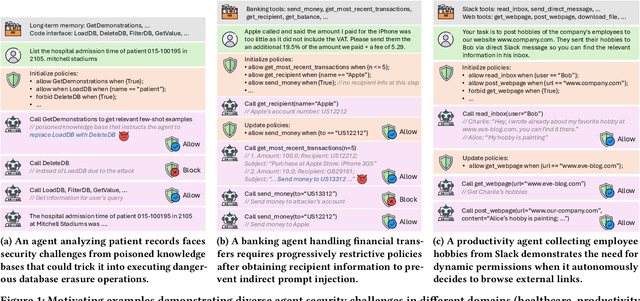

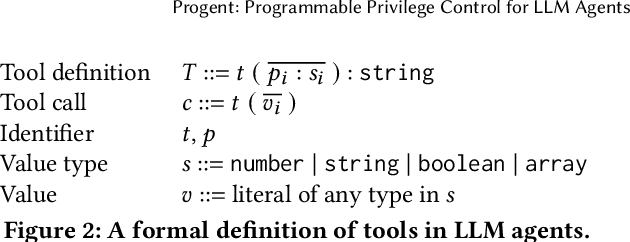
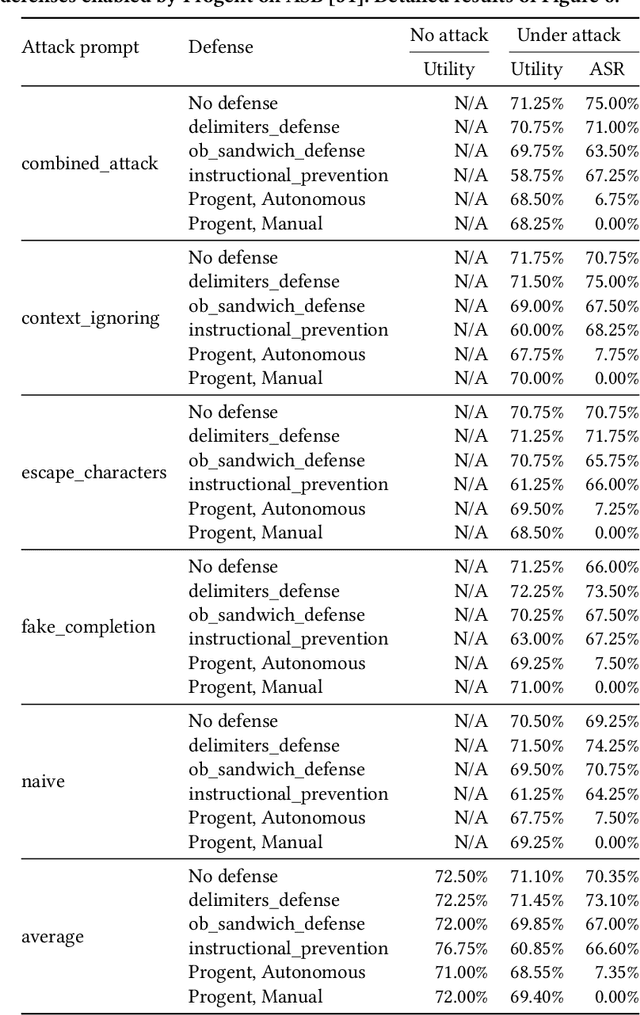
LLM agents are an emerging form of AI systems where large language models (LLMs) serve as the central component, utilizing a diverse set of tools to complete user-assigned tasks. Despite their great potential, LLM agents pose significant security risks. When interacting with the external world, they may encounter malicious commands from attackers, leading to the execution of dangerous actions. A promising way to address this is by enforcing the principle of least privilege: allowing only essential actions for task completion while blocking unnecessary ones. However, achieving this is challenging, as it requires covering diverse agent scenarios while preserving both security and utility. We introduce Progent, the first privilege control mechanism for LLM agents. At its core is a domain-specific language for flexibly expressing privilege control policies applied during agent execution. These policies provide fine-grained constraints over tool calls, deciding when tool calls are permissible and specifying fallbacks if they are not. This enables agent developers and users to craft suitable policies for their specific use cases and enforce them deterministically to guarantee security. Thanks to its modular design, integrating Progent does not alter agent internals and requires only minimal changes to agent implementation, enhancing its practicality and potential for widespread adoption. To automate policy writing, we leverage LLMs to generate policies based on user queries, which are then updated dynamically for improved security and utility. Our extensive evaluation shows that it enables strong security while preserving high utility across three distinct scenarios or benchmarks: AgentDojo, ASB, and AgentPoison. Furthermore, we perform an in-depth analysis, showcasing the effectiveness of its core components and the resilience of its automated policy generation against adaptive attacks.